
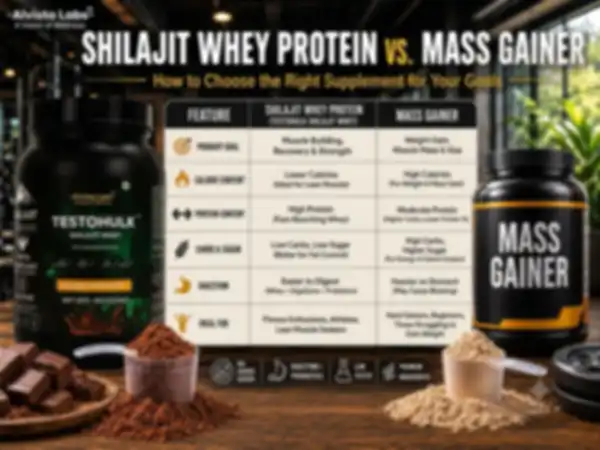
Shilajit Whey Protein vs. Mass Gainer: How to Choose the Right Supplement for Your Goals
Written by: Krishna Kant Tyagi (Founder & CEO, Alvista Labs)
Reviewed by: Ankit Jha (BAMS, M.D.)
If you've stood in front of a supplement shelf—or scrolled through fifty tabs at 1 a.m.—trying to decide between whey protein and a mass gainer, you're not alone. It's one of the most common points of confusion for anyone looking to build muscle, and the marketing on both sides doesn't make it any easier.
Throw a newer, premium category like Shilajit-infused whey protein into the mix, and the decision gets even more layered.
The Quick Verdict
- Choose whey protein (including Shilajit whey) if your goal is to build lean muscle, hit your daily protein targets, and support recovery without adding excess body fat.
- Choose a mass gainer only if you are a "hard gainer," naturally underweight, or struggle to consume enough daily calories through whole foods alone.
Shilajit Whey vs. Mass Gainer: Quick Comparison
FeatureShilajit Whey ProteinMass GainerPrimary PurposeMeet daily protein needs & support active recoveryEasily hit a daily calorie surplus for weight gainCalories per Serving~140–160 kcal~500–1,200+ kcalProtein per Serving~20–30g~20–50g (heavily diluted by carbs)Key Carbohydrate SourceMinimal (typically < 3g)High (Maltodextrin, oat flour, etc.)Active AdditivesShilajit, Ayurvedic adaptogens, digestive enzymesCreatine, simple sugars, healthy fatsBest ForLean muscle gain, recovery, and daily nutritionNaturally thin individuals, high-volume athletesRisk of Fat GainVery LowModerate to High (if surplus is unchecked)
What Is Whey Protein, Exactly?
Whey protein is a fast-digesting, high-quality byproduct of milk coagulated during cheese production, prized for its exceptionally high concentration of essential amino acids and rapid absorption rate. It is rich in leucine, an essential amino acid that [clinical research on PubMed] has proven to be the primary metabolic trigger for muscle protein synthesis—the biological process your body uses to repair and rebuild muscle fibers after intense resistance training.
A typical single-scoop serving delivers roughly 20 to 30 grams of pure protein with negligible fats and carbohydrates. It acts as an incredibly efficient, low-calorie tool for fitness enthusiasts who already consume enough daily calories but need help meeting their daily protein macronutrient targets without overshooting their caloric budget.
What Is a Mass Gainer?
A mass gainer is a high-calorie, nutrient-dense supplement formulation designed to assist individuals in achieving a caloric surplus for weight gain and muscle hypertrophy. While mass gainers do contain dietary protein, the vast majority of their caloric load is derived from complex and simple carbohydrates (such as maltodextrin or finely ground oat flour) and healthy fats.
A single serving of a premium mass gainer can deliver anywhere from 500 to over 1,200 calories. These supplements are strictly formulated to make consistent hypercaloric eating convenient for "hard gainers"—individuals with exceptionally fast metabolic rates, poor natural appetites, or intense physical training regimens who struggle to eat enough solid food.
Where Does Shilajit Whey Protein Fit In?
At its core, Shilajit whey protein delivers the same rapid-absorption protein profiles and muscle-building amino acids as standard whey. The key differentiator is the inclusion of traditional Ayurvedic adaptogens formulated directly into the protein powder.
- Shilajit: A mineral-rich organic resin sourced from the high altitudes of the Himalayas. Traditional Ayurvedic medicine and modern [scientific studies on NCBI] suggest that highly purified Shilajit supports cellular energy production (specifically adenosine triphosphate, or ATP), natural vitality, and metabolic stamina.
- Synergistic Herbs: When combined with standardized extracts of Gokshura, Kapikacchu, and Black Musli, the blend aims to support natural hormonal balance, improve systemic recovery, and reduce muscle fatigue.
- Enhanced Digestion: Premium formulations often integrate specific prebiotics and digestive enzymes to assist with protein breakdown and alleviate the digestive bloating commonly associated with standard whey concentrates.
How to Choose a Safe, High-Quality Shilajit Whey
If you choose to invest in a premium, adaptogen-infused protein to optimize your physical performance, you must be selective. Because Shilajit is a natural mineral resin sourced from rock formations, verifying purity is critical to avoid accidental consumption of heavy metals.
Always verify these three quality benchmarks before buying:
- Third-Party Certifications: Only buy from brands that manufacture in facilities certified by globally recognized bodies such as ISO and GMP and utilize NABL-accredited laboratory testing.
- Heavy Metal Clearance Certificates: Ensure the brand explicitly tests for and certifies that its Shilajit resin is entirely free from harmful levels of lead, arsenic, cadmium, and mercury.
- Label Transparency: Avoid formulations hidden behind "proprietary blends." The label should clearly list the exact milligram dose of Shilajit and accompanying herbs per single serving.
A Premium, Lab-Tested Option: TESTOHULK™ Shilajit Whey Fast-Absorb Protein
If you are looking for a formulation that checks all of these rigorous safety, purity, and quality benchmarks, TESTOHULK™ Shilajit Whey Fast Absorb Protein was built specifically to bridge this gap.
Each scoop delivers 25g of high-quality fast-absorbing whey protein, paired with 250mg of purified Himalayan Shilajit resin, Gokshura, Kapikacchu, and Black Musli. To ensure optimal digestion and eliminate post-shake bloating, the formula includes a targeted prebiotic and probiotic digestive blend.
Manufactured in ISO- and GMP-certified, state-of-the-art facilities, every batch is NABL lab-tested to guarantee it is free from banned substances and heavy metals—giving you a clean, safe, and elite performance supplement.
Summary: Which One Should You Buy?
- Buy Shilajit Whey Protein if your primary fitness goals are lean muscle gain, muscle maintenance during fat loss, enhanced recovery, overall energy, and convenient daily nutrition without excess caloric load.
- Buy a mass gainer if you are naturally thin ("ectomorph"), struggle to put on weight despite heavy lifting, have an incredibly fast metabolism, and require a fast, liquid way to consume an extra 800+ calories per day.
Frequently Asked Questions (FAQs)
Q1: Why do some doctors express caution over whey protein?
Medical caution is typically limited to individuals with pre-existing kidney disease (as high protein increases renal workload), severe lactose intolerance, or those using unverified brands that risk heavy metal contamination. For healthy individuals, high-quality whey is completely safe.
Q2: How much protein does a 70 kg man need daily?
According to [ISSN guidelines], active individuals looking to build muscle should consume 1.6 to 2.2 grams of protein per kilogram of body weight daily. For a 70 kg individual, the math is simple:
Daily Protein Target = 70kg ✕ [1.6, 2.2 ] g / kg = [112, 154 ] grams
Q3: Creatine vs. Whey Protein: Which should I buy first?
Prioritize whey protein first. Whey provides the essential structural building blocks (amino acids) your body requires to physically repair and grow muscle tissue. Creatine solely enhances cellular energy (ATP) for gym performance. Lock in your baseline protein intake before adding creatine.
Q4: Does whey protein increase creatinine levels?
Yes, a high-protein diet—whether from whey or whole foods—can cause a minor, temporary spike in blood creatinine levels. In healthy individuals, this is a normal metabolic adaptation and does not indicate kidney damage. Always inform your doctor about your diet before routine blood tests.
Q5: What is the "2-Hour Protein Rule"?
The strict "anabolic window" is a fitness myth. You do not need to chug a shake immediately post-workout; consuming protein within 1 to 2 hours is perfectly fine. Ultimately, your total daily protein intake matters far more than perfect nutrient timing.
Disclaimer: This article is for general informational and educational purposes only and does not constitute medical advice. Please consult with a qualified healthcare professional before beginning any new supplement regimen, especially if you have pre-existing medical conditions, are taking prescription medications, or are pregnant or nursing